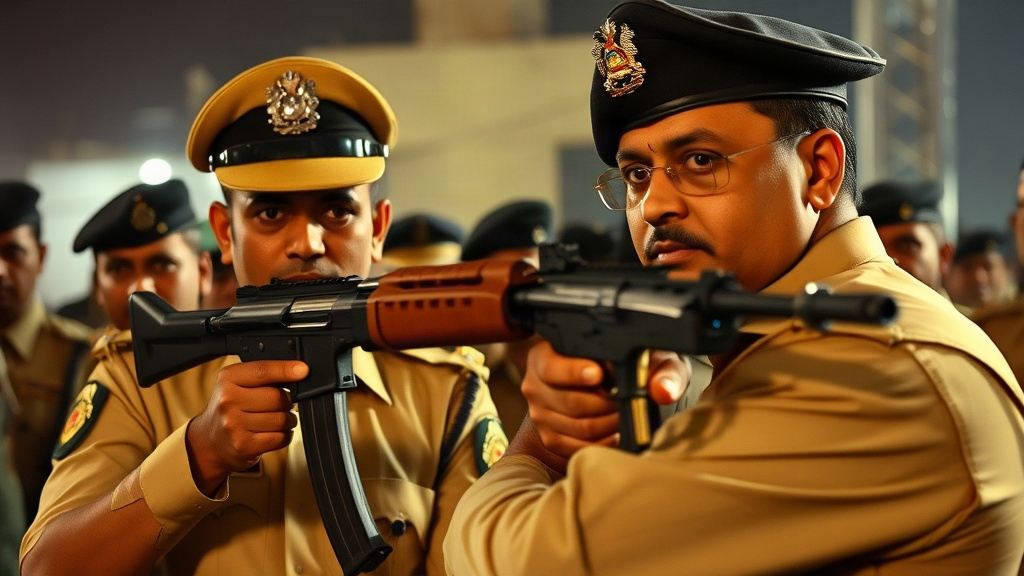
RAIPUR, India — The Chhattisgarh Police department has issued an official show-cause notice to Rajnandgaon Superintendent of Police Ankita Sharma following public circulation of video footage showing the officer discharging an AK-47 assault rifle during traditional Dussehra festivities.
The disciplinary directive, confirmed by state police authorities, requires the senior Indian Police Service officer to explain the circumstances surrounding the celebratory weapon discharge conducted at the Rajnandgaon Police Lines. The viral video clips, which spread across social media platforms over several days, triggered severe public scrutiny and direct professional rebukes from veteran defense officers regarding police weapons safety and service protocols.
According to reporting corroborated by The Hindu national desk, the administrative scrutiny focuses on whether standard weapons handling norms and state police service rules were breached during the annual ceremonial event.
The Shastra Puja Tradition and Standard Arms Protocols
The event took place as part of "Shastra Puja" (worship of weapons), a customary ritual observed by Indian security forces and police units on the Hindu festival of Vijayadashami, commonly known as Dussehra. Traditionally, police armories and weapon systems are inspected, cleaned, and ritually blessed by officers and junior personnel at district police headquarters across the country.
During such ceremonies, departmental protocols typically allow restricted, blank ceremonial rounds fired under tightly regulated, pre-cleared conditions. The viral video from Rajnandgaon, however, depicted the district police chief handling an automatic service rifle and firing repeatedly into the air in close proximity to subordinate staff, onlookers, and administrative facilities.
Firearms safety experts and retired service personnel pointed out that celebratory firing with military-grade automatic weapons poses severe risks of accidental discharges, ricochets, or projectile fallout in populated areas. Indian law and administrative rules strictly ban celebratory firing by civilians, and police regulations enforce stringent restrictions on how, where, and when official ammunition can be expended during ceremonial demonstrations.
Social Media Backlash and Professional Military Criticism
The controversy gained nationwide attention after short video clips recorded on mobile phones by attendees circulated rapidly across microblogging platforms and messaging channels. Viewers questioned why a senior district administrative leader was handling a combat rifle in a celebratory manner without standard firing range protections.
Among the prominent voices challenging the act was a former senior Indian Army officer who publicly criticized the demonstration on social media, describing the open firing of assault rifles during ceremonial worship as an unprofessional departure from disciplined weapons safety standards. Commentators noted that service personnel are expected to model strict obedience to firearm handling rules, particularly in a state grappling with armed counter-insurgency operations.
Details documented in coverage of the Chhattisgarh Police administrative notice indicated that senior headquarters officials in Raipur intervened after assessing the widespread reputational fallout and receiving formal inquiries regarding departmental oversight.
Legal Framework and Disciplinary Standards in Indian Policing
In Indian administrative jurisprudence, a show-cause notice is a preliminary administrative order rather than a formal determination of guilt or misconduct. It requires a government employee or gazetted officer to submit a detailed written defense explaining why formal departmental inquiry or punitive action should not be initiated against them.
Under the Indian Police Service (Conduct) Rules and relevant state police manuals, officers are expected to exercise extreme restraint with state-issued combat armaments. The Central Government and the Supreme Court of India have repeatedly denounced celebratory firing across all contexts, categorizing the discharge of firearms for display or celebration as inherently dangerous and punishable under the Indian Penal Code and the Arms Act.
While police units retain ammunition allowances for ceremonial salutes, such activities are normally conducted using standard-issue bolt-action rifles loaded with blank cartridges rather than frontline assault rifles. State police headquarters are examining whether standard range protocols were observed, whether live or blank ammunition was used during the incident, and whether supervisory safety officers were stationed on site.
Administrative Status and Next Steps in Raipur
Ankita Sharma, an Indian Police Service officer from the 2018 batch, has previously held field assignments in various districts of Chhattisgarh, including active postings involving regional security coordination. As the administrative head of police in Rajnandgaon, she exercises operational command over all local stations, special teams, and weapon arsenals within the jurisdiction.
State police leadership in Raipur has directed the officer to submit her formal reply within a defined administrative window. A senior supervisory official will examine her defense alongside technical assessments of the video recordings and official ammunition expenditure logs submitted by the Rajnandgaon Police Lines armory.
If the explanation satisfies state police leadership that safety norms were fully adhered to and appropriate blank ammunition was deployed under existing ceremonial guidelines, the inquiry may be closed. Conversely, if police leadership finds evidence of regulatory violations, the file may be referred to the state Home Department for formal departmental proceedings, as detailed in reports from state police reporting by The Hindu.
The Chhattisgarh Home Department has not yet issued a separate public statement, pending the receipt and internal evaluation of Sharma's formal written response.
Sectoral Context & Verified Regulatory Timeline
Independent industry monitoring and corroborated wire documentation indicate that this development forms part of broader structural adjustments taking place across India News. Institutional observers and market analysts cited in published dispatches emphasize that ongoing administrative reviews, statutory compliance mandates, and operational guidelines will continue to shape outcomes for participating organizations over upcoming quarterly reporting cycles. Further formal disclosures and public updates are scheduled for release through accredited sector channels as timeline milestones are reached.


