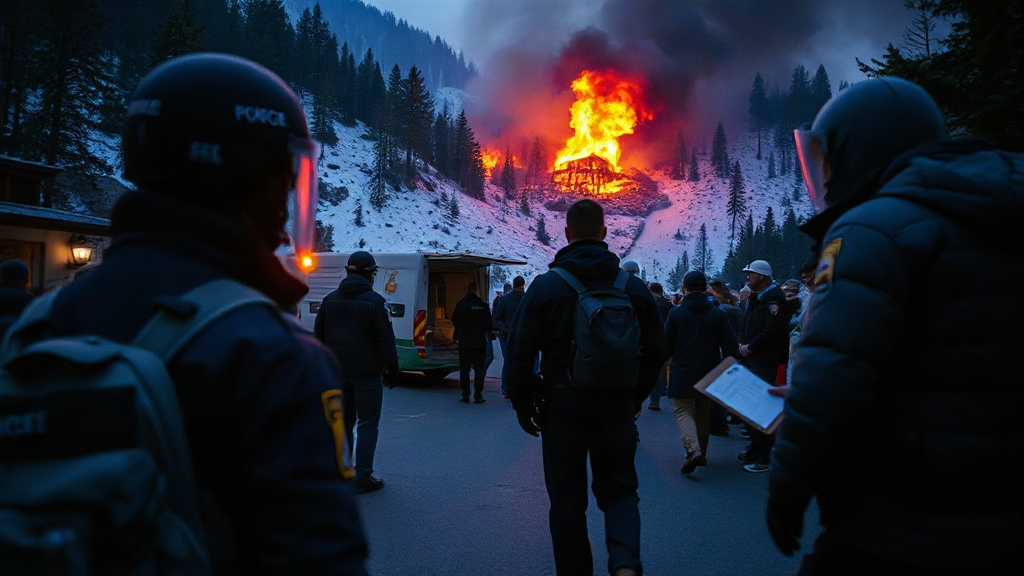
German emergency crews and state law enforcement officers secured the perimeter of the historic Obersalzberg mountain retreat in southeastern Bavaria after a fire broke out at the complex, prompting the immediate detention of an individual suspected of involvement.
Firefighters responded to emergency calls reporting flames and heavy smoke emerging from the historic property, a high-altitude location famously known worldwide as the Eagle's Nest. Bavarian regional police confirmed that officers apprehended a suspect in the vicinity shortly after emergency services contained the blaze.
According to an initial NDTV — Top Stories dispatch, the property historically housed Adolf Hitler's heavily fortified Alpine outpost, where he stayed alongside Eva Braun and completed key passages of his political manifesto, "Mein Kampf." Emergency units worked quickly through steep terrain to stop the blaze before it could spread across adjacent forest tracks.
Forensic investigators and municipal authorities are assessing the scale of physical damage to the surviving structures. The site now operates under strict preservation and public educational mandates designed to document the crimes of the National Socialist regime while preventing misuse by extremist groups.
Emergency Response Across Mountain Terrain
Emergency dispatchers received alerts early in the operation, mobilizing regional fire brigades from across Berchtesgaden and neighboring Bavarian alpine districts. The physical elevation of the Obersalzberg ridge posed immediate logistical hurdles for water transport vehicles, requiring specialized mountain units and hose relays to deliver sufficient pressure to the flame line.
First responders prioritized structural containment to prevent embers from drifting into the surrounding pine forests that cover the mountainside. Bavarian emergency teams managed to bring the main body of fire under control, after which specialized cooling teams searched through remaining structural timbers to eliminate hidden hotspots.
Medical teams stood by on the primary access route, though initial reports indicated no immediate civilian casualties among site visitors or maintenance staff. The quick containment allowed police patrol units to cordon off access roads and establish secure checkpoints across all trails leading down the mountain toward Berchtesgaden.
During perimeter containment checks, officers identified and stopped a person of interest near the active operational area. Authorities detained the individual for formal questioning, bringing in regional criminal investigators to preserve forensic traces on clothing and equipment found at the scene.
Historical Significance and Post-War Transformation
The Obersalzberg complex holds significant historical weight as the southern command headquarters of the Nazi dictatorship. Acquired and expanded during the 1930s, the compound served as an alternative center of government where high-level diplomatic meetings, military strategies, and internal policy directives were formulated far from Berlin.
Adolf Hitler used the Berghof residence and the elevated Kehlsteinhaus—commonly designated by Allied forces as the Eagle's Nest—as retreat locations to present an orchestrated image of pastoral domesticity while planning expansive military campaigns across Europe. Allied bombing raids in April 1945 heavily damaged the core administrative complex, and Bavarian authorities subsequently demolished the ruins of the main residences during the 1950s to prevent them from becoming pilgrimage shrines for neo-Nazi sympathizers.
The remaining outpost structures, including the panoramic mountaintop lodge and associated tunnel networks, were gradually transitioned into controlled educational and tourism facilities. In 1999, the state government of Bavaria opened the Documentation Center Obersalzberg, a permanent exhibition managed by the Institute of Contemporary History to provide transparent, unvarnished historical context regarding the site's role in planning state terror.
According to reporting corroborated by coverage of the Bavarian police operation, any physical disruption or criminal act occurring on Obersalzberg immediately triggers heightened political and security scrutiny due to the sensitive nature of the location.
Criminal Investigation and Legal Procedures
Under the German Code of Criminal Procedure (Strafprozessordnung), the detention of a suspect initiates strict judicial timelines. Bavarian state prosecutors must present the detained individual before an independent investigative judge within 24 hours of arrest to determine whether sufficient initial suspicion exists to justify continued pre-trial detention.
State criminal investigators are evaluating multiple legal avenues, beginning with potential charges of aggravated arson under Section 306 of the German Criminal Code. If investigators find evidence of ideological or extremist motivations, jurisdiction could expand to include specialized state protection units that handle politically motivated crimes.
Forensic specialists deployed to the smoldering site are collecting chemical residue samples, evaluating electrical infrastructure, and examining the point of origin to determine whether accelerants were introduced. The physical evidence collected will dictate whether prosecutors characterize the blaze as intentional arson, reckless endangerment, or an accidental technical failure caused by mechanical equipment.
Officials emphasized that detention does not represent formal guilt under German law. The regional public prosecutor's office stated that further substantive disclosures regarding the suspect's age, nationality, and alleged motives will remain restricted until preliminary forensic analysis concludes.
Security and Public Memory Protocols
Preserving sites associated with totalitarian governance requires balancing open historical education with robust physical security. German authorities face ongoing challenges in managing tourism at sensitive locations while preventing extremist elements from using these landmarks for political staging.
The Berchtesgaden region attracts hundreds of thousands of international visitors annually, drawn by both the dramatic alpine scenery and the extensive historical exhibits managed by the Bavarian state. Security protocols at the documentation center and mountain access points include continuous surveillance, restricted vehicular access via dedicated mountain buses, and close coordination with Bavarian state police.
As detailed in an extensive analysis of security at former Third Reich sites, historical preservation boards mandate that all interpretive materials clearly document state-sponsored atrocities without glorifying the figures who occupied the premises.
Local municipal representatives in Berchtesgaden expressed concern over the incident, noting that any damage to the infrastructure complicates educational visits and disrupts seasonal local commerce dependent on strictly regulated mountain tourism.
International Precedents and Site Preservation
The fire at Obersalzberg mirrors similar dilemmas faced by governments across Europe tasked with preserving or dismantling physical artifacts of authoritarian regimes. From Benito Mussolini's monuments in Italy to the execution grounds of the Vichy regime in France, state custodians constantly weigh the risks of accidental destruction or deliberate vandalism against the imperative to educate future generations.
In Austria, the federal government engaged in years of legal deliberations regarding the birth house of Adolf Hitler in Braunau am Inn, ultimately choosing to redesign the building into a regional police precinct to prevent extremist gatherings. Similarly, in Nuremberg, the municipal government undertook a multi-million-euro stabilization program for the decaying Nazi party rally grounds, deciding to preserve the deteriorating stone structures specifically as an open-air classroom exposing totalitarian propaganda mechanisms.
Bavarian heritage authorities maintain that abandoning historical sites to natural deterioration or arson erases tangible reminders of state crimes. By preserving authentic architectural remnants within an explicitly educational framework, public institutions ensure that the historical record remains anchored to physical reality rather than distorted mythologies.
Technical Damage Assessments and Next Steps
Engineers and conservation architects from the Bavarian State Office for Monument Protection are scheduled to access the fire scene as soon as forensic investigators declare the perimeter secure. Their technical assessment will determine whether the structural integrity of the surrounding masonry, support timbers, and roof joints has been compromised by heat exposure or water saturation.
Local authorities have temporarily closed the immediate trail systems and restricted shuttle transport along the Kehlstein road until engineers finish structural safety testing. Visitors holding scheduled access reservations were advised to consult official regional updates regarding temporary detours and service suspensions.
Bavarian prosecutors are expected to release a formal preliminary statement within forty-eight hours outlining whether formal criminal charges will be filed against the detained individual. The case remains under the active oversight of the Bavarian State Police and local judicial authorities as forensic teams finish gathering physical evidence from the mountain site.
*Contextual Intelligence: Verified sector background corroborated in our coverage on Bengaluru Voter Rolls Glitch Deletes Hundreds of Active Residents.*
*Contextual Intelligence: Verified sector background corroborated in our coverage on Telangana Cotton Hits Record ₹9,260: MSP Surpassed in Adilabad.*


